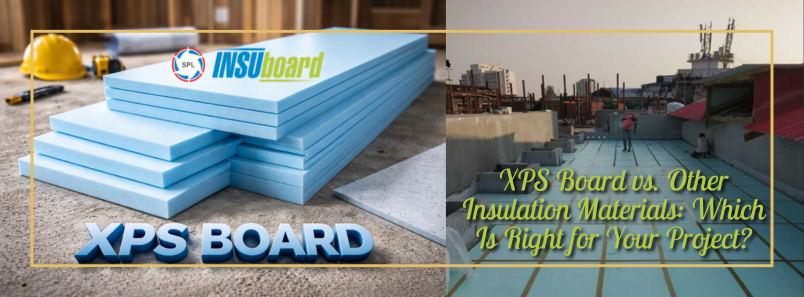
XPS Board vs. Other Insulation Materials: Which Is Right for Your Project?
Choosing insulation isn’t just about cost — moisture resistance, durability, and long-term thermal performance matter more. This comparison helps builders, homeowners, and project planners understand when XPS boards outperform other materials and where alternatives make sense....
When it comes to insulation, the options can feel overwhelming. Walk into any building supply store and you'll find foam boards, batts, spray foam, and more - each claiming to be the best. But if you've been doing your research, you've probably come across the term 'XPS board' more than once. And for good reason.
This post breaks down how XPS compares to other common insulation materials so you can make a smarter choice for your specific project, without the jargon overload.
First, What Exactly Is an XPS Board?
XPS stands for Extruded Polystyrene. It's a rigid foam insulation board made by pushing polystyrene through a die, which gives it a closed-cell structure. That closed-cell makeup is what makes XPS boards dense, moisture-resistant, and durable over the long haul.
You'll find them used in floors, walls, roofs, cold storage units, and even below-grade applications like foundations and basements. They're lightweight and easy to cut, and they don't absorb water, which is a bigger deal than most people realise.
XPS Board vs. EPS (Expanded Polystyrene)
EPS is probably the most common comparison people make. It's the white beaded foam you see used in packaging, and yes, it's also used in construction. EPS costs less than XPS and is available in a range of densities, so it can work well in many scenarios.
But here's the difference: EPS has an open-cell structure at the bead boundaries, which means it can absorb some moisture over time. In dry environments or above-grade applications, that might not be a big deal. However, in areas with ground contact or high humidity, XPS holds up better. Its thermal resistance (R-value) also stays more stable over time compared to EPS, which can lose some performance when wet.
For long-term performance in demanding conditions, XPS has the edge.
XPS Board vs. Fibreglass Batts
Fibreglass batts are probably the most widely used insulation in homes, the pink or yellow fluffy rolls you stuff between wall studs. They're affordable, widely available, and easy to install in standard wall cavities.
The issue? Fibreglass doesn't handle moisture well at all. Once it gets wet, it clumps, loses its insulating ability, and can even become a mould risk. It also doesn't add any structural rigidity to a wall.
XPS boards, on the other hand, are rigid panels that add a continuous layer of insulation without thermal bridging (where heat escapes through studs or framing). This makes XPS a much better fit for external wall insulation, roofing systems, or any place where moisture exposure is a concern.
XPS Board vs. Spray Foam
Spray foam is impressive in the right situations. It expands to fill gaps and cracks, giving you an excellent air seal - something rigid boards can't fully match on their own. Closed-cell spray foam also performs very well in terms of R-value per inch.
The tradeoff? Cost and complexity. Spray foam requires professional application, which adds to the expense. It's also nearly impossible to remove or adjust once applied. For large, flat surfaces like floors, flat roofs, or cold storage walls, XPS boards are far more practical, cost-effective, and just as reliable when installed correctly.
So, which one is right for you?
It honestly depends on your project. Here's a simple way to think about it:
If you're insulating a basement, floor slab, flat roof, or cold storage unit - XPS board is a strong choice. It handles moisture, pressure, and temperature changes without losing performance.
If you're doing standard wall cavities on a tight budget, fibreglass or EPS might get the job done.
If you need to fill irregular gaps or hard-to-reach areas, spray foam makes more sense.
But for versatility, durability, and consistent thermal performance across a wide range of applications, XPS boards are hard to beat. They're not the cheapest option upfront - but they tend to pay for themselves over time by maintaining their insulating properties and requiring little to no maintenance.
At Shivsons, we manufacture high-quality XPS boards suited for residential, commercial, and industrial insulation needs. If you're not sure which thickness or grade fits your project, feel free to get in touch, we're happy to help you figure it out.