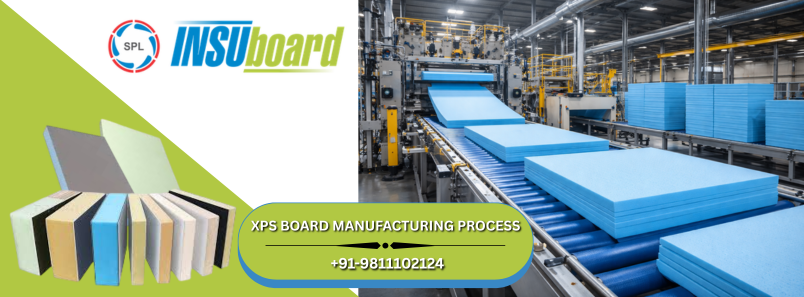
How Are XPS Boards Manufactured for Insulation and Construction Use?
The strength of modern construction lies in smart materials—and XPS boards are a perfect example. With advanced manufacturing processes and superior insulation properties, they not only enhance building durability but also improve energy efficiency, making them a reliable choice for long-term performance....
Introduction
Insulation is essential for improving energy efficiency, durability, and structural performance in contemporary construction. XPS (Extruded Polystyrene) board is one of the most popular materials for this use.
XPS boards are widely used in buildings, cold storage, and infrastructure projects because of their strength, moisture resistance, and thermal insulation qualities.
But have you ever wondered how these high-performance boards are manufactured? The entire XPS board manufacturing process, as well as its advantages and uses, will be covered in this guide.
What is an XPS Board?
XPS (Extruded Polystyrene) board is a rigid foam insulation material made from polystyrene. It has a closed-cell structure, which makes it highly resistant to moisture and provides excellent thermal insulation.
It is commonly used in:
- Roof insulation
- Wall insulation
- Flooring systems
- Cold storage units
- Infrastructure projects
Leading manufacturers like XPS Board India provide high-quality boards designed for long-term performance in construction.
Raw Materials Used in XPS Board Manufacturing
The quality of an XPS board depends on the raw materials used:
- Polystyrene resin
- Blowing agents
- Additives (for strength and fire resistance)
- Colorants (for identification)
These materials are carefully selected to ensure durability, insulation efficiency, and safety.
Step-by-Step XPS Board Manufacturing Process
1. Mixing of Raw Materials
Polystyrene resin is mixed with additives and blowing agents to create a uniform base material.
2. Extrusion Process
The mixture is fed into an extruder where it is heated and melted under high pressure.
3. Foam Expansion
As the material exits the extruder, pressure drops and the blowing agent expands, forming a closed-cell foam structure.
4. Shaping & Calibration
The foam is shaped into boards of required thickness and size using molds and calibration tools.
5. Cooling Process
The boards are cooled to stabilize their structure and maintain dimensional accuracy.
6. Cutting & Finishing
After cooling, boards are cut into standard sizes and surface finishes are applied if needed.
7. Quality Testing
Final products undergo strict quality checks for:
- Density
- Compressive strength
- Thermal conductivity
- Water absorption
Manufacturers like XPS Board India follow advanced production techniques and quality standards to ensure reliable performance.
Key Features of XPS Boards
- High thermal insulation
- Excellent moisture resistance
- Strong compressive strength
- Lightweight and easy to handle
- Long lifespan
These features make XPS boards ideal for both residential and commercial construction.
Applications of XPS Boards
Construction Sector
- Roof insulation
- Wall cladding
- Basement insulation
Infrastructure Projects
- Roads and highways
- Railway tracks
- Airport runways
Industrial Use
- Cold storage insulation
- Warehouses
- Refrigeration units
With high-quality solutions from XPS Board India, these applications become more efficient and durable.
Benefits of XPS Board in Construction
Energy Efficiency
Reduces heat transfer, lowering energy consumption.
Durability
Maintains performance for years without degradation.
Moisture Resistance
Prevents water absorption and damage.
Cost-Effective
Offers long-term savings due to reduced maintenance and energy costs.
Latest Trends in XPS Board Manufacturing (2026)
- Eco-friendly blowing agents
- Improved fire-retardant properties
- High-density insulation boards
- Advanced extrusion technology
Companies like XPS Board India are adopting these innovations to meet modern construction demands.
XPS vs Other Insulation Materials
|
Feature |
XPS Board |
EPS |
PU Foam |
|
Water Resistance |
High |
Medium |
Low |
|
Strength |
High |
Medium |
High |
|
Insulation |
Excellent |
Good |
Excellent |
|
Durability |
Long-lasting |
Moderate |
High |
XPS boards stand out for their moisture resistance and durability.
Common Mistakes to Avoid
❌ Using low-quality boards
❌ Ignoring proper installation
❌ Choosing incorrect thickness
❌ Not checking certifications
Avoiding these ensures maximum performance and longevity.
Why Choose XPS Board India?
When it comes to reliable insulation solutions, XPS Board India offers:
- Premium quality boards
- Advanced manufacturing process
- Consistent product performance
- Suitable for multiple applications
- Cost-effective solutions
Their products are designed to meet modern construction standards and long-term durability needs.
Conclusion
Understanding the XPS board manufacturing process helps you make informed decisions for construction and insulation projects. From raw material selection to advanced extrusion and quality testing, every step ensures high performance and reliability.
If you’re looking for trusted and high-quality insulation materials, XPS Board India provides solutions that deliver strength, efficiency, and durability.
FAQs
What is the XPS board manufacturing process?
It involves mixing raw materials, extrusion, foam expansion, shaping, cooling, and quality testing.
Where are XPS boards used?
They are used in roofs, walls, floors, cold storage, and infrastructure projects.
Are XPS boards waterproof?
Yes, they have a closed-cell structure that resists water absorption.
How long do XPS boards last?
They can last for decades with proper installation.