Extruded Polystyrene Board Manufacturer in Himachal Pradesh: How Boards Are Made

Shiv Sons
In Himachal Pradesh, insulation is not just a finish. Our product has to cope with wide temperature fluctuations, moisture, and extreme operating conditions in buildings, cold-stores, industrial buildings and many other structures.
This is the reason why selecting the suitable insulation board is more than a matter of thickness or price.
If you are looking for the Extruded Polystyrene Board Manufacturer in Himachal Pradesh, then it's interesting for everyone about how they are actually manufactured to know. It's most of all important as the manufacturing process affects the cell structure density thermal performance and compressive strength of the board.
What Is an Extruded Polystyrene Board?
XPS- is short for Extruded Polystyrene, a rigid foam board insulation material that is produced by an extrusion process.
XPS differs from other forms of insulation like loose fill or foam by its manufacture into a continuous rigid board with a closed cell structure. This structure accounts for its thermal and moisture resilience.
The material has applications in various construction areas like in roofs, floors, walls, and in cold-storage applications.
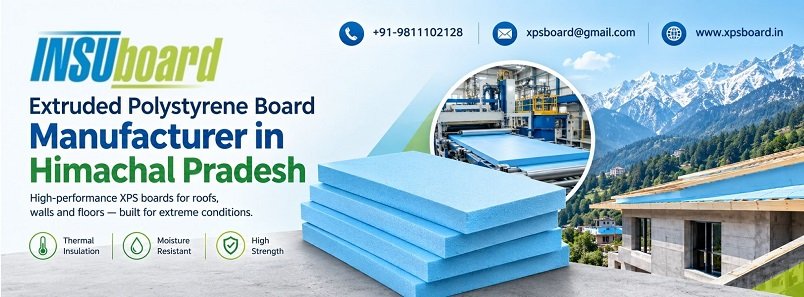
ShivSons produces XPS insulation boards that are branded as INSUboard within their line-up. They are available for roof, wall, and floor application.
How Are XPS Boards Manufactured?
The process begins with the preparation of the raw materials.
According to XPS Board’s product information, the basic formulation for its INSUboard includes GPPS (General Purpose Polystyrene), master batch, fire-retardant additives and an environmentally friendly blowing agent.
The manufacturing process can broadly be understood in a few stages.
1. Raw Material Preparation
The polystyrene resin and other necessary additives are prepared based on the desired product formulation.
The ratio and blend of the material are important because it determines how the material reacts in the mixture and foam.
2. Melting and Mixing
The material undergoes pass into the system.
Polystyrene is made workable by the use of warm temperature and mechanical action inside the extruder. Through the process, additives, and the blowing agent are added to the plastic.
This stage takes controlled processing, because the end foam structure is greatly affected by what occurs in the extruder system before the material leaving the system.
3. Extrusion and Foam Formation
This is the stage that XPS is named after.
The processed material is forced through an extrusion die, where it expands and takes shape as a continuous sheet of rigid foam. During this expansion and cooling process the process creates a closed cell structure.
This makes it a solid insulation board unlike one comprised of individual pieces of foam.
4. Cooling and Board Formation
After extrusion, the foam needs to stabilise and cool.
The continuous board is then processed into usable dimensions. Depending on the manufacturing setup and product requirements, finishing may include cutting, edge treatment and dimensional control.
Consistency is important here. Boards intended for construction need predictable dimensions so that they can be installed with appropriate joints and detailing.
Why Does the Manufacturing Process Matter?
It's simple to glance at an insulation board and think it's just another lightweight board.
But it is only in the process of manufacturing that it does something.
The efficiency of a board in a specific application depends on its density, cell morphology, thermal conductivity and compressive strength.
At present, ShivSons has different specifications for INSUboard used as roof, wall, or floor. Refer to recent ShivSons specifications document, samples of INSUboard have a 300kPa (N/mm2) compressive strength, for roof grade, 180kPa for wall grade and 500kPa for floor grade while having a 0.0289 W/m.k listed thermal conductivity.
This is one of the most important points: each of the different XPS boards is proper in one specific application and not in the others.
XPS Boards for Projects in Himachal Pradesh
A project in Himachal Pradesh may have very different insulation requirements depending on whether the board is being installed in a residential building, commercial property, industrial floor, roof system or cold-storage facility.
For example, wall insulation may require a different balance of thermal performance and handling characteristics than a floor exposed to substantial static loads.
INSUboard’s wall-grade products are listed for exterior walls, interior walls, cavity walls and EIFS applications. The floor grade is intended for applications including industrial floors and cold storage. Roof-grade boards are listed for overdeck and underdeck insulation, roof gardens, parking areas and flat-roof renovation applications.
What Should Buyers Ask an XPS Manufacturer?
Before choosing an Extruded Polystyrene Board Manufacturer in Himachal Pradesh, or sourcing XPS boards for a project there, it is worth checking:
- What grade is suitable for the application?
- What is the board’s thermal conductivity?
- What compressive strength is available?
- What density does the product have?
- What thicknesses and dimensions are available?
- Is the product intended for roof, wall or floor use?
- Can technical specifications be provided for project approval?
- Can the supplier support the required quantity and delivery schedule?
These questions can prevent a common mistake: selecting an insulation board based only on its thickness or quoted price.
Choosing an XPS Board Supplier
ShivSons is engaged in construction and insulation from 1991 with XPS Board division, serving the INSUboard construction and industry product range for roof, wall, and floor. The listed Trading address is Ghaziabad, Uttar Pradesh, India while the company delivers product and technical data for various XPS grades.
It is recommended that for buyers of Himachal Pradesh, to gain advantage, they should consider network discussion in case of project application, required grade and number, delivery requirement before finalising the product.
Great insulation begins well before the board is even delivered to site. The quality of raw materials, the extrusion process, foam structure and final specifications can all influence the performance of the finished board.
So next time if you are searching for an Extruded Polystyrene Board Manufacturer in Himachal Pradesh, then instead of the location keyword thinking; above what is being a Product Specification and how the Board being manufactured.