XPS Board Manufacturing Line: Equipment, Process & Production Capabilities

Shiv Sons
When you look at an XPS insulation board, the finished product appears fairly simple: a rigid, lightweight sheet designed to reduce heat transfer.
The manufacturing process behind it is more involved.
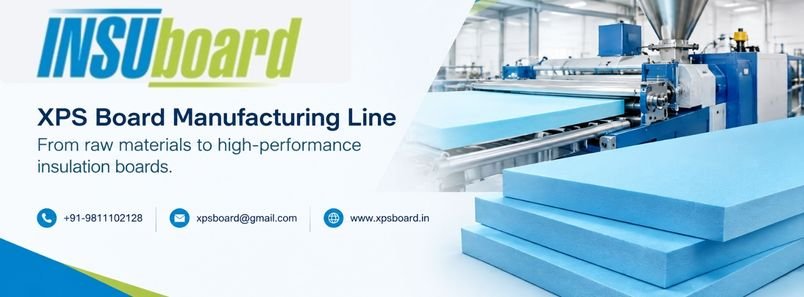
An XPS Board Manufacturing Line combines material preparation, controlled extrusion, foam formation, cooling and board finishing to produce insulation boards with consistent dimensions and performance. The quality of each stage can influence the final board's thermal properties, density, strength and suitability for different construction applications.
What Goes Into an XPS Board?
XPS stands for Extruded Polystyrene. Unlike a conventional solid plastic sheet, XPS is produced as a closed-cell foam through an extrusion process.
According to ShivSons' XPS Board website, its INSUboard uses GPPS (General Purpose Polystyrene), master batch, fire-retardant additives and an environmentally friendly blowing agent as basic raw materials.
The formulation needs to be controlled carefully because the material composition ultimately affects how the foam behaves during extrusion and expansion.
How the Manufacturing Line Works
The process can be understood as a sequence of connected stages rather than one machine doing everything.
1. Raw Material Preparation
Polystyrene resin and the required additives are prepared according to the intended product specification.
At this stage, consistency matters. Variations in the material mix can affect the downstream extrusion and foam structure.
2. Mixing and Feeding
The prepared materials are blended and introduced into the extrusion system.
The objective is to create a uniform feed so that the extrusion process remains stable.
3. Extrusion
This is the central stage of XPS production.
The material enters an extruder, where it is heated and processed under controlled pressure. The resin becomes workable and combines with the blowing system before being pushed toward the forming section.
ShivSons describes its XPS boards as rigid boards manufactured through an extrusion process.
4. Foam Expansion
As the material leaves the high-pressure extrusion environment, the pressure changes and the blowing agent expands.
This creates the characteristic closed-cell foam structure associated with XPS insulation boards. ShivSons' manufacturing guide also describes this pressure-drop and expansion stage as part of the XPS production process.
The control of this stage is particularly important because the resulting cell structure influences the board's insulation and moisture-resistance characteristics.
5. Cooling and Stabilisation
The newly formed board needs to cool and stabilise before it can be accurately finished.
Controlled cooling helps the product retain its intended shape and dimensions.
6. Sizing and Finishing
Once the board has stabilised, it can be cut or finished according to the required dimensions.
Depending on the manufacturing setup and product specification, finishing may involve trimming edges, adjusting dimensions and preparing boards for packing.
Equipment Typically Involved
A complete XPS production setup generally involves several interconnected sections.
|
Manufacturing Stage |
Typical Equipment/Section |
Main Purpose |
|
Material preparation |
Mixing and feeding system |
Prepare consistent raw-material feed |
|
Plastic processing |
Extruder |
Melt and process the polymer |
|
Foam formation |
Die/forming section |
Create the continuous foam board |
|
Cooling |
Cooling/calibration section |
Stabilise board dimensions |
|
Sizing |
Cutting/trimming equipment |
Produce required board dimensions |
|
Finishing |
Surface/edge finishing section |
Prepare boards for use or packing |
|
Packing |
Packaging system |
Protect finished boards during handling |
The exact configuration depends on the required board specifications, production scale and manufacturing technology.
Production Capability Is More Than Output
A manufacturing line should not be judged only by how many boards it can produce.
For insulation products, consistency is equally important.
A production system needs to maintain control over factors such as:
- Board thickness
- Density
- Cell structure
- Thermal conductivity
- Compressive strength
- Dimensional accuracy
- Surface quality
- Moisture absorption characteristics
For example, ShivSons lists different INSUboard grades for roof, wall and floor applications, with different compressive-strength specifications. Its published figures include 300 kPa for roof grade, 180 kPa for wall grade and 500 kPa for floor grade, measured at 10% deformation.
That difference shows why one generic XPS formulation may not be appropriate for every application.
Where XPS Boards Are Used
The manufacturing requirements become easier to understand when you look at the applications.
Roof insulation:
XPS boards can be used for overdeck and underdeck insulation, including certain flat-roof and roof-garden applications.
Wall insulation:
Wall-grade boards are used for exterior walls, interior walls, cavity walls and EIFS applications.
Floor insulation:
Higher-strength grades can be used in demanding flooring applications, including industrial floors and cold-storage environments.
This is why manufacturers need to match board characteristics with the intended application rather than treating every XPS board as identical.
What to Check When Evaluating an XPS Production Line
If you are assessing an XPS manufacturing setup or sourcing boards from a manufacturer, ask:
- What raw materials are used?
- How is the extrusion process controlled?
- What board densities are available?
- What thermal conductivity is achieved?
- What compressive-strength grades are offered?
- What thicknesses and dimensions can be produced?
- How consistent is the finished board?
- What applications is each grade designed for?
- How are finished boards handled and packed?
These questions provide a better picture of production capability than looking at machinery size alone.
ShivSons and XPS Board Manufacturing
XPS Board is a division of ShivSons, a company that says it has been involved in construction and insulation since 1991. Its current portfolio includes roof, wall and floor insulation boards under the INSUboard range.
The company publishes technical information for its different grades, including thermal conductivity, density, compressive strength and intended applications. Its current site lists a thermal conductivity value of 0.0289 W/m.K for the roof, wall and floor grades shown on the website.
For buyers, this kind of product-specific information is more useful than simply knowing that a board is labelled "XPS."
Looking Beyond the Machinery
An XPS production line is ultimately valuable because it needs to deliver a consistent insulation product.
The extruder, forming section, cooling system and finishing equipment all have a role, but the final result depends on how well the complete process is controlled.
For construction, cold storage, industrial flooring, roofing or wall insulation, the important question is therefore not simply how XPS boards are manufactured, but whether the resulting board has the right properties for the job.
For XPS insulation requirements, explore the roof, wall and floor-grade INSUboard range from ShivSons at XPS Board.